

MORE THAN DISTRIBUTION
Management and development of originator and innovative medicines on the Polish market
We combine our experience in the hospital sector with the resources required to provide comprehensive support for a specific product or project. We can begin preparations even before a reimbursement decision has been made, and then manage the agreed scope of sales, tendering, logistics and operational processes.
B2B consultation
PRODUCT SUPPORT AT EVERY STAGE
We support manufacturers of originator and innovative medicines at the various stages of a product’s market launch and market presence
We tailor the scope of our cooperation to the nature of the product, the method of its financing and procurement, and the requirements of the specific project. We can provide support even before sales commence, and subsequently manage the agreed processes relating to tendering, sales, stock and distribution.
More Less
We have experience in handling products used in drug programmes and Emergency Access to Drug Technologies (RDTL), as well as products requiring specialist logistics facilities.
1
An innovative product prior to marketing authorisation
PRODUCT STATUS
The product is being prepared for launch on the Polish market, but is not yet in regular circulation and sales or distribution have not yet commenced.
MANUFACTURER’S PRIORITY
Assessment of market and procurement conditions, and preparation of plans for the future management of the product following its marketing authorisation: potential distribution channels, logistical requirements, stock levels, and the scope of data and processes to be implemented.
WHAT WE AGREE ON
We analyse the available data on the market, prices, procedures and purchasing methods for products that constitute the agreed benchmark. We set out requirements for future sales, stock, warehousing, transport and reporting, which can be prepared before regular sales commence.
2
Product authorised for marketing prior to the start of sales
PRODUCT STATUS
The product has been authorised for sale, but no stock has yet been prepared, nor have sales, distribution and day-to-day order processing commenced.
MANUFACTURER’S PRIORITY
Translating the product’s formal readiness into operational readiness: establishing a sales and distribution model, preparing the initial stock and setting out the procedures for warehousing, transport, order fulfilment, invoicing and reporting, as well as the allocation of responsibilities.
WHAT WE AGREE ON
We agree on the service model, ownership and financing of stock, invoicing arrangements, sales channels, warehousing and transport requirements, the scope of reporting, and the after-sales processes covered by the partnership.
3
Product prior to the launch of a regular funding or procurement process
PRODUCT STATUS
The product is being prepared for general sale, but the intended method of financing or purchasing it has not yet been put in place. For many innovative therapies, the reimbursement process is a crucial stage.
MANUFACTURER’S PRIORITY
Preparing in advance the processes required once the regular financing or procurement process has been launched.
WHAT WE AGREE ON
We determine the possible methods of purchasing and financing the product, potential customer groups, and requirements regarding stock, warehousing, transport, order fulfilment and reporting. We also take into account the operational requirements associated with the implementation of the product within the pharmaceutical programme or the RDTL.
4
The product, once the financing or purchase has been secured
PRODUCT STATUS
The product has a secure basis for funding or procurement, but regular orders have not yet commenced. Depending on the approach taken, further systemic, organisational and procurement measures may be required before these orders begin.
MANUFACTURER’S PRIORITY
The allocation of the secured funding or procurement budget to contracts and deliveries.
WHAT WE AGREE ON
Based on the available data, we determine the procurement method and the appropriate scope of support for tendering processes, quotations, sales and orders, and we prepare stock levels and delivery readiness appropriate to the project. This also applies to products used in pharmaceutical programmes, for which it is necessary to transition from a guaranteed funding base to the efficient management of centres and deliveries.
5
Regular sales and distribution of the product
PRODUCT STATUS
The product is sold on a regular basis and requires ongoing management of orders, contracts, stock, deliveries, documentation and reporting in accordance with the agreed cooperation model.
MANUFACTURER’S PRIORITY
Ensuring product availability and the efficient fulfilment of orders, whilst maintaining the agreed level of control and a clear division of responsibilities.
WHAT WE AGREE ON
We establish procedures for stock management, sales and order processing, contract fulfilment, storage and transport conditions, reporting and other processes covered by the collaboration. We tailor the scope to the actual requirements of the specific product.
6
Extending the scope or changing the service model
PRODUCT STATUS
The product is already on the market, but the manufacturer wishes to expand the scope of services, redistribute responsibilities between the parties, or change the existing model, operator or distributor.
MANUFACTURER’S PRIORITY
Adapting the way the product is managed to meet new needs whilst ensuring the continuity of day-to-day operations.
WHAT WE AGREE ON
We identify which elements of the model require expansion or modification: sales, procurement, order fulfilment, stock, distribution, reporting, ownership of goods or the division of responsibilities. If the change involves an existing operator or distributor, we also define the scope and timetable for the handover of processes.
7
Limited availability or product discontinuation
PRODUCT STATUS
There is a limited supply of this product; the available stock needs to be organised, or the manufacturer is planning to temporarily restrict or cease supplies of it.
MANUFACTURER’S PRIORITY
To organise stock, outstanding orders and liabilities to customers, and to plan future service provision within the agreed scope.
WHAT WE AGREE ON
We set out the procedures for managing available stock, outstanding orders and active contracts, the terms for future deliveries and – where applicable to the project – returns, adjustments, settlements and communication with customers.
From need to solution
-
From reimbursement to regular orders
01
THE CHALLENGE
Obtaining a reimbursement paves the way for sales, but does not yet guarantee regular orders. The ability to sell also depends on the purchasing readiness of healthcare facilities, procurement procedures, and the preparation of stock and deliveries.
SOLUTION
We help translate reimbursement into the product’s commercial and operational readiness. We analyse purchasing patterns and available data on buyers, monitor relevant procedures, manage the agreed stages of tendering and contract conclusion, and prepare sales, stock and distribution to fulfil orders.

-
Concentration of purchases at selected healthcare facilities
02
THE CHALLENGE
Purchases of specialist products may be concentrated in a specific group of outlets and may begin at different times. It is therefore important for the partner not only to know where the product can be purchased, but also when and how sales opportunities arise.
SOLUTION
Based on the available data, we identify where purchases and tenders relating to the product or the agreed reference group are concentrated. We analyse the timing and method of purchase, and then determine the scope of monitoring for tenders, sales and order fulfilment.

-
Support tailored to the requirements of a specific product
03
THE CHALLENGE
Highly specialised products may require a bespoke approach to stock levels, storage and transport conditions, delivery times, reporting and the allocation of responsibilities. Where a product is of high value, striking a balance between its availability and the level of stock held is also of particular importance.
SOLUTION
We begin by defining the product and project requirements. On this basis, we establish the level and principles of stockholding, storage and transport conditions, the method of handling orders and deliveries, the scope of reporting, and the roles of the parties involved. We can combine various service elements into a single agreed model, tailored to the specific product’s requirements and the partner’s expected level of control.





01 / 03
CHOOSING A MODEL OF CO-OPERATION
How do we work?
We develop a cooperation model for a specific product or project, taking into account the partner’s needs and expectations, market realities, sales and purchasing methods, ownership and financing of stock, the division of responsibilities, and legal, regulatory and quality requirements. We can operate in various roles and combine elements of several solutions into a single agreed model.
-
Distributor
In our own name and for our own account
We purchase specific batches of products and resell them as a pharmaceutical wholesaler. The scope of our collaboration may include maintaining an agreed stock level, warehousing, sales, deliveries, reporting, invoicing and the day-to-day management of processes relating to distribution.
-
Operational partner
On behalf of and for the benefit of the manufacturer, under the relevant authorisation
We carry out agreed activities relating to a specific product or project on behalf of and for the benefit of the manufacturer, on the basis of a contract and the relevant authorisation. The scope may include selected tendering, sales, logistics, operational, reporting or communication processes, in accordance with the agreed division of responsibilities.

-
Consortium
Joint tendering for a contract or the implementation of a project
We combine our own expertise with that of our partner in a specific case or project. We agree on the scope of our collaboration, representation, the division of tasks and responsibilities, and the terms governing sales, deliveries and invoicing.

01 / 03
quality and safety
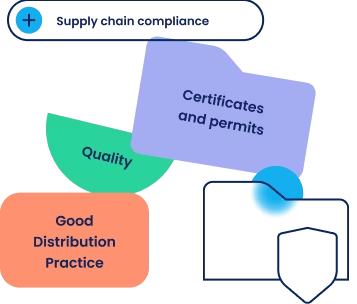
Quality in a pharmaceutical wholesaler
01 Standards and certificates
We operate in accordance with the requirements of the Pharmaceutical Law and Good Distribution Practice. Our quality management system sets out the principles for the supervision and validation of distribution processes to the required extent.

Certificates
02 Permits and licences
We engage in the wholesale trade of medicinal products under a licence issued by the Chief Pharmaceutical Inspector. We also hold the additional authorisations and licences required to operate in selected areas subject to special supervision.
Our authorised activities include:
- wholesale trade in medicinal products
- wholesale trade in narcotic drugs and psychotropic substances
- wholesale trade in Category 1 narcotic precursors
- trade in unsealed radioactive sources
- storage of radioactive sources and waste
03 Compliance and safety in the supply chain
Urtica’s Quality System covers all key stages of the handling of medicinal products – from the qualification of suppliers and the receipt of products into the warehouse, through their proper storage and distribution, to their release to the authorised recipient. Each of these stages is subject to specific procedures, controls and documentation, which enables us to maintain the required quality standards and ensure product safety.
As part of the Quality System, we carry out, amongst other things:
- the qualification, assessment and periodic verification of suppliers and customers,
- inspection of incoming deliveries for compliance with requirements and documentation,
- monitoring of storage conditions, including temperature and humidity, in accordance with the requirements for individual products,
- supervision of transport conditions and the correct handling of deliveries,
- ensuring full traceability of products at each stage of distribution,
- verifying customers’ authorisation prior to the completion of a sale,
- supervising products requiring special storage or transport conditions,
- maintaining and supervising quality documentation relating to the processes carried out,
- handling non-conformities, complaints and incidents that may affect product quality,
- implementing procedures for the suspension and withdrawal of products from the market,
- implementing corrective and preventive actions where required by the results of monitoring or the analysis of an incident.
Contact
Get in touch with us
*mandatory fields