

MORE THAN DISTRIBUTION
Pharmaceutical distribution and commercial support for generic medicines in Poland
We combine 35 years of experience in the Polish hospital market with tendering, sales, stock management and distribution capabilities for generic medicines. We tailor the scope of cooperation to your product or portfolio – from support in selected processes to taking responsibility for an agreed commercial and operational scope.
B2B consultation
PRODUCT SUPPORT AT EVERY STAGE
We support generic medicine manufacturers at every stage of product development
The needs we identify depend on the product’s stage of development. We can support a pharmaceutical product before marketing authorisation, after authorisation has been granted, before reimbursement, once it is reimbursed, during regular distribution, and when the existing service model needs to be reviewed.
1
A generic medicine before marketing authorisation
PRODUCT STATUS
The product is at the planning stage or undergoing the marketing authorisation procedure. It is not yet commercially available, and sales and distribution have not started.
MANUFACTURER’S PRIORITY
Assessing market conditions and the product’s potential, and defining the arrangements for supporting it after marketing authorisation: the possible distribution channel, logistics requirements, expected scale, stock levels and the processes to be put in place.
WHAT WE AGREE ON
We analyse available data on the market, prices, competition and purchasing arrangements, and assess what will be needed to support the product at a later stage. We identify potential distribution channels, storage and transport requirements, reporting needs and the processes worth preparing before sales begin.
2
An authorised product before its first sale
PRODUCT STATUS
The product has marketing authorisation, but sales, stocking, distribution and day-to-day order handling have not yet started.
MANUFACTURER’S PRIORITY
Translating regulatory readiness into operational readiness. Preparing initial stock and arranging warehousing, transport, order handling, invoicing, reporting and the first deliveries.
WHAT WE AGREE ON
We agree on the service model, stock ownership, financing arrangements and expected stock levels, invoicing, the distribution channel, reporting frequency and scope, and the handling of complaints, returns and adjustments related to distribution.
3
A generic medicine before reimbursement
PRODUCT STATUS
The product is due to enter the reimbursed market, or the manufacturer wants to prepare for its possible inclusion in reimbursement.
MANUFACTURER’S PRIORITY
Preparing product support for a potential change in scale if reimbursement is granted. Estimating demand, stock levels and availability, and defining the distribution channel, reporting arrangements and readiness to serve customers.
WHAT WE AGREE ON
We focus on the product’s operational readiness if reimbursement is granted. We agree on a plan for stocking, distribution, reporting and order handling, and for preparing to serve hospitals, pharmacies or both.
4
After reimbursement or before hospital orders
PRODUCT STATUS
The product is reimbursed or is intended for a channel in which tenders, pricing, deadlines, contracts and delivery readiness are important.
MANUFACTURER’S PRIORITY
Ensuring practical support for the product in the market: stock availability, monitoring tender procedures, analysing prices and competition, preparing bids and readiness to deliver on time.
WHAT WE AGREE ON
We establish whether the product requires support with tender procedures, sales to healthcare facilities, bid preparation, contract fulfilment, reporting and day-to-day cooperation with customers.
5
Regular distribution of a generic medicine
PRODUCT STATUS
The product is already present in the channel and needs ongoing support with orders, deliveries, stock, documents, reports, complaints, returns, adjustments and settlements.
MANUFACTURER’S PRIORITY
Maintaining availability, monitoring stock turnover and levels, reducing the operational workload and keeping post-delivery processes transparent.
WHAT WE AGREE ON
We agree on stock levels, the warehousing model, reporting frequency, transport conditions, complaints and returns handling, adjustments, settlements and communication with customers.
6
Scaling up or changing the service model
PRODUCT STATUS
The product is already on the market, but needs greater scale, better control of availability, broader sales and customer support, or a change to its existing service model.
MANUFACTURER’S PRIORITY
Identifying which elements of the current model limit sales volumes, service efficiency, or control over stock and costs.
WHAT WE AGREE ON
We assess whether the product needs an analysis of prices and competition, changes to stocking arrangements, expanded sales and order handling, communication or field activities, wider distribution, or a change in the existing division of responsibilities.
7
Limited availability or product discontinuation
PRODUCT STATUS
The product is in limited supply, requires stock to be managed, or the manufacturer plans to temporarily reduce or discontinue deliveries.
MANUFACTURER’S PRIORITY
Managing stock, deliveries, fulfilment of ongoing tenders, customer communication, returns, settlements and documentation through a structured process.
WHAT WE AGREE ON
We agree on a plan for handling the remaining stock, arrangements for completing outstanding deliveries, customer communication, returns, adjustments and settlements, and the scope of Urtica’s support with post-delivery processes.
From need to solution
-
Price positioning and product potential
01
THE CHALLENGE
Pricing, the level of competition, reimbursement conditions and potential volumes influence a generic medicine’s potential. Before launching sales or changing the current model, it is worth analysing the opportunities to develop the product or portfolio.
SOLUTION
We analyse prices, competition, tender procedures, sales and purchasing arrangements. We help establish whether the product needs tender support, sales and order handling outside tenders, warehousing, stocking, information activities or a tailored service model.

-
Turning product availability into orders
02
THE CHALLENGE
The product is available, but this is not translating into enquiries or orders. The cause may be pricing, insufficient information about product availability, healthcare facilities’ purchasing cycles, customers’ established habits or a lack of market feedback.
SOLUTION
We help identify the stage at which a barrier arises. Our field team maintains contact with the hospital market and gathers feedback from healthcare facilities. The Contact Centre can handle enquiries from authorised customers, provide operational information and coordinate order-related matters. Information activities can help reach professional audiences within the permitted scope.

-
The volume of tender procedures requires ongoing support
03
THE CHALLENGE
Hospital orders are crucial for generic medicines intended for inpatient care. With more products and tender procedures, ongoing market monitoring, bid preparation, deadline management and subsequent contract fulfilment can take up a significant share of the manufacturer’s resources.
SOLUTION
We take on the agreed scope of work, from monitoring tender procedures and analysing documentation, through preparing bids and concluding contracts, to sales, contract fulfilment and deliveries. We define the scope to complement the manufacturer’s own team or reduce its workload in selected processes.






01 / 03
CHOOSING A COOPERATION MODEL
How do we work?
We tailor the cooperation model to the product or portfolio, the scale of operations and the processes our partner wants to manage independently or entrust to Urtica. We take into account sales and purchasing arrangements, stock ownership and financing, the division of responsibilities, and legal and quality requirements.
-
Distributor
In our own name and for our own account
We purchase specified batches of a product or products from the portfolio and resell them as a pharmaceutical wholesaler. The scope of cooperation may include stocking and maintaining agreed stock levels, warehousing, sales, deliveries, reporting, settlements and the day-to-day handling of distribution-related processes.
-
Operational partner
In the manufacturer’s name and on its behalf, with the appropriate authorisation
We carry out an agreed scope of activities for a product or portfolio in the manufacturer’s name and on its behalf, under a contract and with the appropriate authorisation. This may include selected tendering, sales, logistics, reporting or communication processes, allowing the manufacturer to entrust part of its day-to-day operations to Urtica while maintaining the agreed division of responsibilities.

-
Consortium
Joint tendering for a contract or the implementation of a project
We combine our expertise with that of our partner in a specific tender procedure or project. We agree on the scope of cooperation, representation, the division of tasks and responsibilities, and the arrangements for sales, deliveries and settlements.

01 / 03
quality and safety
Quality in a pharmaceutical wholesaler
01 Standards and certificates
We operate in accordance with the requirements of the Pharmaceutical Law and Good Distribution Practice. Our quality management system sets out the principles for the supervision and validation of distribution processes to the required extent.

Certificates
02 Permits and licences
We engage in the wholesale trade of medicinal products under a licence issued by the Chief Pharmaceutical Inspector. We also hold the additional authorisations and licences required to operate in selected areas subject to special supervision.
Our authorised activities include:
- wholesale trade in medicinal products
- wholesale trade in narcotic drugs and psychotropic substances
- wholesale trade in Category 1 narcotic precursors
- trade in unsealed radioactive sources
- storage of radioactive sources and waste
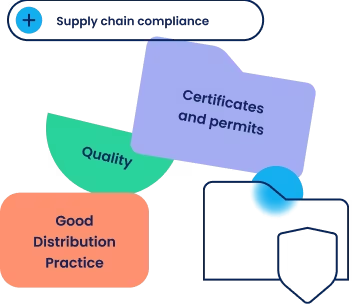
03 Compliance and safety in the supply chain
Urtica’s Quality System covers all key stages of medicinal product distribution, from supplier qualification and receipt of products into the warehouse, through appropriate storage and distribution, to delivery to an authorised customer. Each stage is governed by defined procedures, checks and documentation, helping to maintain the required quality standards and ensure product safety.
Our Quality System includes:
- qualification, assessment and periodic verification of suppliers and customers,
- checking incoming deliveries for compliance with requirements and documentation,
- monitoring storage conditions, including temperature and humidity, in line with the requirements for individual products,
- supervising transport conditions and the proper delivery process,
ensuring full product traceability at each stage of distribution, - verifying customers’ authorisations before completing sales,
supervising products that require special storage or transport conditions, - maintaining and overseeing quality documentation relating to the processes carried out,
- handling non-conformities, complaints and events that may affect product quality,
- implementing procedures for suspending distribution and recalling products,
taking corrective and preventive action where required by monitoring results or incident analysis.
Contact
Get in touch with us
*mandatory fields