
Management of the preparation of cytostatic drugs in a hospital pharmacy and the minimisation of financial losses in the Polish context
In this article, you will learn:
- What is the scale of losses associated with the preparation of cytostatic drugs, and what causes them?
- Why unused leftover medicines and errors in the preparation process can result in significant costs
- how dose consolidation and appropriate planning of treatment sessions can minimise wastage; how software and automation support the preparation of cytostatic drugs and help to minimise errors
- Why does the method of accounting for vial overfill affect the cost-effectiveness of treatment?
- What might a model approach to improving cost-effectiveness look like – from identifying the medicines that generate the greatest losses, through the organisation of work and the implementation of software, to monitoring the results?
About this publication
Abstract
Polish hospital pharmacies lose between 6 per cent and 17 per cent of the value of the cytostatic drugs they purchase through the disposal of unused active substances. This situation is attributable to individual dosing, the National Health Fund’s (NFZ) failure to reimburse vial overfill, and human error. Cost-effectiveness is improved by dose consolidation and the automation and robotisation of processes; however, their fully optimal utilisation requires a methodical and systematic approach.
Keywords
production optimisation, drug waste management, vial overfill
Introduction
The scale of the problem
Expenditure on cancer medicines is among the fastest-growing items in the budgets of hospitals and public payers, and a significant proportion of these costs relates to biologics and targeted therapies [1, 2].
At the same time, analyses show that between 6 and 17 per cent of the value of cytostatic drugs is lost as a result of individual dosing, limited stability following reconstitution or the first use of a vial, and errors and inefficiencies caused by human factors [3, 4]. With expenditure of 8.69 billion PLN in 2023, losses from unused milligrams of medicines can be estimated at 521 million PLN (6%) – PLN 1.48 billion (17 per cent) [5].
Furthermore, in Poland, hospitals are reimbursed by the National Health Fund (NFZ) only for the milligrams of medicine actually used, whilst any residue left in the vials is considered a loss. The Fund also does not reimburse vial overfill, which prevents the reimbursement of costs for the preparation and the administration procedure itself. As a result, both hospitals and the payer incur financial losses [6].
This therefore raises the question: what are the causes of the most severe financial losses, and is it possible to counteract them at the level of the cytostatic drug preparation unit?
Sources of losses in the preparation of oncology medicines
Disposal of production residues
Individual dosing of cytostatic agents based on body surface area or body weight prevents the full utilisation of the contents of the vials. Where it is not possible to split doses or where the stability of the preparation has not been confirmed, any unused residue must be disposed of. [1, 4, 7].
Biological cancer drugs are particularly expensive in this context. They are characterised by a high price per milligram, and their shelf life is often limited to 24 hours at 2–8°C. It should be emphasised that the storage time is often limited due to the traditional method of preparing infusions outside an aseptic environment. These issues mean that even small percentages of leftover medication result in significant financial losses [8–10]. It is estimated that between 1 per cent and as much as approximately 33 per cent of the prepared quantity of biological medicines may be wasted as unused residues, generating additional costs amounting to around 10 per cent of the value of the medicines purchased [1].
However, if the manufacturer takes into account the preparation of the medicinal product under validated aseptic conditions, it turns out that the same monoclonal antibodies can remain stable for as long as 1 to 3 months. Generic trastuzumab products serve as an example here. In the case of Herceptin or Trazimer, the shelf life declared by the manufacturer is 48 hours after reconstitution, and 24 hours after preparation of the intravenous (i.v.) infusion [11, 12]. Ogivri, on the other hand, remains stable for 10 days after reconstitution and for 30 days after dilution in saline [13]. These losses are therefore partly due to outdated regulatory requirements, rather than the actual physicochemical stability of the oncology preparations [8, 10].
Human error during the preparation of medicines
The manual preparation of anticancer drugs involves several stages and carries a risk of errors at every stage: dose calculation, selection of vials, reconstitution, dilution and labelling.
An analysis of irregularities in the preparation of intravenous anticancer drugs allows errors to be categorised as operational errors visible in the finished product and latent errors resulting from faulty procedures [14, 15]. One significant problem remains the incorrect final volume of the preparation, as 35.9 per cent of preparations breach the standards regarding the permissible excess of solution in the bag, which affects the final concentration and the risk of leakage [15].
Another group of errors consists of labelling irregularities, affecting around 28.3 per cent of products. These include, amongst other things, applying labels outside the laminar flow cabinet and manually transcribing data, which drastically reduces the legibility and completeness of the information. Such practices significantly increase the risk of medication administration errors [14, 15].
Hidden errors, on the other hand, include working with multiple similar substances in a single area, as well as a failure to optimise vial sizes, resulting in losses amounting to 28.98 per cent of the value of the medicines. [14].
Understanding the sources of losses and the associated causes of errors in the process of preparing cancer medicines enables the introduction of corrective measures that will lead to improved cost-effectiveness in cancer treatment.
Process optimisation methods
Dose consolidation and planning of treatment sessions
One way of reducing wastage is to share vials of expensive medicines with a short shelf life. However, improving cost-effectiveness requires coordinating the treatment sessions of patients taking the same medicine to a single day of the week [1, 3, 7, 16, 17].
Data from overseas centres point to significant economic benefits. At the National Institute of Oncology in Rabat, Morocco, sharing vials over a six-month period resulted in savings of $246,031.40 whilst preparing 18,218 preparations. This equates to a saving of $13,504.85 for every 1,000 infusions prepared by the hospital pharmacy [18]. Unfortunately, the author of the study does not provide the baseline figures used to calculate the savings. It is therefore not possible to determine the percentage savings.
An analysis carried out by Liu et al. [19] showed savings of 50.5 per cent in the cost of disposed medicines. It should be emphasised, however, that the preparation of infusions was carried out using a cytostatic robot, which is an additional factor contributing to cost-effectiveness.
Looking at the situation in Poland, despite record underfunding of the National Health Fund (NFZ) and hospital debt at the end of 2025, the number of publications on optimising the costs of preparing cytostatic drugs remains negligible. [20]. Walczuk’s analysis [21] demonstrated the economic benefits of preparing cytostatic drugs in a central cytostatic drug preparation unit rather than on individual wards. These benefits are largely linked to the consolidation of preparations for multiple wards. The data showed that wastage fell from 1.71% to 1.25% of the value of medicines purchased, i.e. by 26.9%. In the quarter under review, this generated savings of PLN 21,159.87.
The second publication also focused on the benefits of establishing a central cytostatic preparation unit. In it, Zuziak et al. [22] highlight the economic benefits, which consist of a 77.28% reduction in wastage during the drug preparation stage. In nominal terms, this result represented annual savings of 572,276.07 PLN.
Unfortunately, given the year in which they were published, these articles are now out of date. Bearing in mind the cost of biologics, sharing vials could bring much greater benefits. Trastuzumab emtansine can serve as a theoretical example. This medicine is used in the B.9.FM drug programme: Treatment of Patients with Breast Cancer (ICD-10: C50) [23]. The dosage of this drug, at 3.6 mg/kg for an average body weight of 70 kg [24], requires the administration of 250 mg of the drug. The use of 200 mg vials, priced at 4,041.14 PLN, results in a loss of 3,030.86 PLN per cycle, which, with 14 administrations, amounts to 42,432.04 PLN per course of treatment. As each patient requires 1 and 1/4 vials, consolidating the treatment into 4 sessions reduces the disposal cost to almost zero [23].
It is clear that calculating the optimal batch size and the sharing of vials by staff is difficult, particularly when dealing with a wide variety of medicines. The use of specialised software and the automation of the production process can therefore be helpful in the optimisation process.
Software
Research by Maren and Waterson [25] showed that the implementation of automated software to manage the preparation of medicinal products reduced the time taken to prepare cytostatic drugs by 35 per cent. Similar conclusions are drawn from a systematic review conducted by Baston et al. [26]. Although, unfortunately, the authors do not provide specific figures, they state that the average time taken and the accuracy of preparation have improved significantly.
In Poland, the modernisation of hospital infrastructure is currently underway, including as part of the National Recovery Plan, which involves the integration and expansion of IT systems and the digitisation of medical records. As part of this, record sums are to be allocated to the expansion and modernisation of hospitals and cancer centres, as well as their digitisation [23, 27–29].
Automation
Robots for the preparation of cytostatic drugs, such as APOTECAchemo, CytoCare, KIRO and Equashield, improve dosing accuracy and reduce preparation errors [30–32]. A systematic review showed that robots achieve preparation accuracy ranging from 0% to ±3% of the prescribed dose for 97.5% of the preparations, whilst the remaining 2.5% of intravenous infusions fell within a ±5% deviation from the prescribed dose [31]. In contrast to automated production, the manual preparation of medicinal products may be subject to errors outside the acceptable range in 8% to as many as 20% of the preparations produced, which has implications for cost-effectiveness [32].
In Poland, the number of centres implementing robotisation in the preparation of cytotoxic drugs is growing. Since 2023, the Hospital Pharmacy of the University Clinical Centre in Gdańsk has been operating an advanced Equashield system featuring AI algorithms and four arms, and in January 2026 an additional Mundus Mini unit was commissioned. Meanwhile, at the Świętokrzyskie Oncology Centre, the Central Cytotoxic Drug Preparation Unit was opened in March 2025, combining full automation with semi-automation, which enables the preparation of approximately 300–400 doses per day [33–35].
It should be borne in mind, however, that the implementation of robotisation is most suitable for centres with a high volume of treatments, well-established therapeutic session planning and a mature IT infrastructure that is fully integrated with electronic chemotherapy ordering systems [30, 36]. Lukanawonakul et al. [32] estimated the break-even point for such an investment at 41,802 doses per year when produced in-house. Where services were extended to include external contractors, however, the break-even point fell to 5,122 doses per year.
The problem of managing vial overfill in the Polish context
Cost-effectiveness could be improved by utilising vial overfill; however, current regulations prevent hospitals from reporting these to the National Health Fund. Paradoxically, the use of such surpluses prevents the reimbursement not only of the milligrams of the medicine, but also of the administration procedure itself. This results in an opportunity cost due to the choice of a less cost-effective solution than administering the excess substance [6, 37].
At the same time, up until 2025, the National Health Fund (NFZ) reimbursed only the dose administered to the patient, leaving hospitals to bear the costs of disposing of any remaining contents from opened vials. This created a financial imbalance in which healthcare facilities lost funds without being able to offset these losses against vial overfill from other products [37, 6]. It is only recently that the payer has agreed to reimburse the total number of vials used per patient. However, this does not solve the problem; it merely shifts the costs to another institution.
According to Professor Maciejczyk, the recovery of vial overfill could amount to approximately 2.35 per cent of the value of the medicines dispensed. With expenditure on cancer medicines expected to reach PLN 8.69 billion in 2023, utilising these surpluses would generate annual savings of around PLN 203.4 million for the healthcare system [6].
A model for implementing a system to improve the cost-effectiveness of cytostatic drug production
Based on the findings presented earlier, it is possible to draw up a model plan for improving cost-effectiveness. The structure of the model serves merely as a framework for further development, so that the proposed solutions can be adapted to the varied organisational circumstances of cytostatic drug preparation units (Fig. 1).
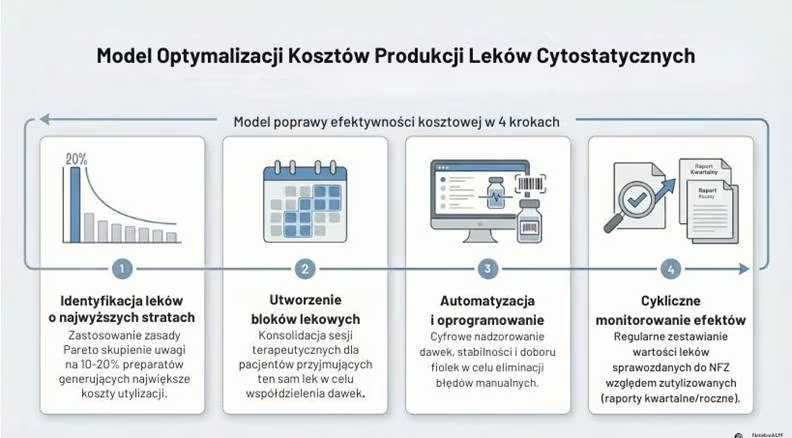
- Identifying the medicines with the highest loss value.
- Identification in accordance with the Pareto principle, which states that 20 per cent of the actions taken account for 80 per cent of the outcomes or results [38];
- Ranking of medicines from highest to lowest annual disposal costs;
- Further efforts to reduce losses should focus on the top 20 per cent of medicines on the list; or, if 20 per cent is too large a number in absolute terms, the focus may be limited to the top 10 per cent;
- In collaboration with oncology departments, draw up a schedule for chemotherapy sessions
- patients on the same medication who attend on one or two consecutive days of the week, so that doses can be shared;
- Although vial overfill cannot be used as an additional reimbursed medicine for the patient, it can nevertheless reduce the quantity of active substance disposed of. Here, the potential should increase in line with the greater number of doses of a given medicine prepared each day;
-
- A programme for monitoring the production of oncology drug infusions should automate and oversee operations at every stage of preparation in order to minimise the risk of human error as much as possible
- Good software controls the following aspects:
- dosage
- selection of the carrier solution and solvent
- drug concentration
- physicochemical stability from the moment the medicine is dissolved until the end of administration
- storage conditions
- a vial calculator that selects the most optimal configuration required to prepare the total quantity of medicinal product in a single batch
-
- Monitoring the value of medicines dispensed or reported to the National Health Fund (NFZ) in relation to those disposed of over a given period, e.g. quarterly, half-yearly or annually
- A comparison of how the changes introduced have improved cost-effectiveness
Process optimisation through automation, dose consolidation and digitisation is essential for improving cost-effectiveness in Polish oncology. Although modern technologies enable a significant reduction in wastage, making full use of them requires the removal of regulatory barriers relating to the billing of vial overfill. A systematic approach to reducing wastage can improve production profitability whilst minimising the risk of human error.
References
- OECD. Addressing Challenges in Access to Oncology Medicines: Analytical Report. Paris: OECD Publishing; 2020
- Likic R. Sustainability of the costs of novel biologics: Are we all heading for bankruptcy? Br J Clin Pharmacol. 2020;86(7):1157–1159.
- Fasola G, Aprile G, Marini L, Follador A, Mansutti M, Miscoria M. Minimising drug waste as an effective strategy for cost containment in oncology. BMC Health Serv Res. 2014;14:57.
- Fulsoundar R, Kadhe N, Patil S, Ghate S, Pawar S. Quantifying Drug Wastage and Economic Loss of Chemotherapy Drugs in the Adult Oncology Department of a Tertiary Care Public Hospital in India. Cureus. 22 November 2023;15(11):e49242.
- https://www.nfz.gov.pl/aktualnosci/aktualnosci-centrali/raport-refundacyjny,8565.html (as at 4 February 2026)
- https://www.mzdrowie.pl/leki/w-gospodarce-lekami-w-szpitalu-jest-wiele-do-poprawy/ (as at 4 February 2026)
- Tiwari A, Kulkarni S, Jadhav B, Menon N, Prabhash K, Nonronha V, et al. Study of the excess cost associated with drug wastage due to limited vial size options for intravenous anti-cancer drugs among patients receiving such treatment at Tata Memorial Hospital. Asian Pac J Cancer Care. 2024;9(4):679–685.
- Bardin C, Astier A, Vulto A, Sewell G, Vigneron J, Trittler R, et al. Guidelines for the practical stability studies of anticancer drugs: A European consensus. Ann Pharm Fr. 2011. doi: 10.1016/j.pharma.2011.07.002.
- Kim J, Chung J, Park S, Jung S, Kang D. Evaluation of the physicochemical and biological stability of reconstituted and diluted SB2 (infliximab). Eur J Hosp Pharm. 2018;25(3):157–164. doi: 10.1136/ejhpharm-2016-001085.
- Vieillard V, Astier A, Paul M. Extended stability of a biosimilar of trastuzumab (CT-P6) following reconstitution in vials, dilution in polyolefin bags and storage at various temperatures. Generics and Biosimilars Initiative Journal (GaBI Journal). 2018;7(3):101–10. doi: 10.5639/gabij.2018.0703.022.
- https://ec.europa.eu/health/documents/community-register/2006/2006102015188/anx_15188_pl.pdf (as at 5 February 2026)
- https://ec.europa.eu/health/documents/community-register/2018/20180726141678/anx_141678_pl.pdf (as at 5 February 2026)
- https://ec.europa.eu/health/documents/community-register/2021/20210818152833/anx_152833_pl.pdf (as at 5 February 2026)
- Gilbert RE, Kozak MC, Dobish RB, Bourrier VC, Koke PM, Kukreti V, et al. Errors in the Compounding of Intravenous Chemotherapy in a Follow-Up Pan-Canadian Observational Study. J Oncol Pract. 20 April 2018. doi: 10.1200/JOP.17.00007.
- Lombardo J, Coles J, Ryszka D, Roussel C, Smith W. Deviations from best practice: findings from a remote-verification observational study by a certified patient safety organisation on the intravenous compounding of chemotherapeutic and ancillary drugs. J Pharm Pract. 2023;36(6):1438–1447. doi:10.1177/08971900221134836.
- Gilbar PJ, Chambers CR, Musicco F. Preventing wastage of drug vials and reducing expenditure associated with injectable cancer drugs: An international oncology pharmacy survey. J Oncol Pharm Pract. 2021;27(8):1854–1861. doi: 10.1177/10781552211024723.
- Athira M, Nongthongbam S, Sinha SK, Meena Devi N. A pharmacoeconomic study on drug wastage. Int J Adv Res. 2020;8(09):1461–1468. doi: 10.21474/IJAR01/11812.
- https://pubmed.ncbi.nlm.nih.gov/37728162/ (as at 5 February 2026)
- Liu H, Zou L, Song Y, Yan J. Cost analysis of implementing a vial-sharing strategy for chemotherapy drugs using intelligent dispensing robots in a tertiary Chinese hospital in Sichuan. Front Public Health. 21 September 2022; 10:936686. doi: 10.3389/fpubh.2022.936686.
- https://www.nfz.gov.pl/aktualnosci/aktualnosci-centrali/ponad-miliard-zlotych-trafil-do-budzetu-nfz-to-dodatkowe-srodki-glownie-na-nadwykonania,8875.html (as at 7 February 2026)
- Walczuk W. Cost savings in hospitals. The cytostatic drug preparation unit. Is it worth it? Farm Pol. 2010;66(2):83–86.
- https://pubmed.ncbi.nlm.nih.gov/25154199/ (as at 7 February 2026)
- https://www.gov.pl/web/zdrowie/obwieszczenie-ministra-zdrowia-z-dnia-18-grudnia-2025-r-w-sprawie-wykazu-refundowanych-lekow-srodkow-spozywczych-specjalnego-przeznaczenia-zywieniowego-oraz-wyrobow-medycznych-na-1-stycznia-2026-r (as at 7 February 2026)
- https://togethermagazyn.pl/srednia-waga-kobiet-w-polsce-aktualne-dane-i-znaczenie-dla-zdrowia/ (as at 7 February 2026)
- Meren ÜH, Waterson J. Evaluating an automated compounding workflow software for safety and efficiency: an implementation study. JMIR Hum Factors. 2021;8(4):e29180. doi: 10.2196/29180.
- Batson S, Mitchell SA, Lau D, Canobbio M, de Goede A, Singh I, et al. Automated compounding technology and workflow solutions for the preparation of chemotherapy: a systematic review. Eur J Hosp Pharm. 2020;27:330–336. doi: 10.1136/ejhpharm-2019-001948.
- https://www.kpo.gov.pl/strony/aktualnosci/kolejna-umowa-na-onkologie-w-ramach-kpo-podpisana-125-mln-zl-dla-szpitala-w-lodzi/ (as at 9 February 2026)
- https://uskwb.pl/2026/01/12/prawie-12-mln-zl-dofinansowania-z-krajowego-planu-odbudowy-na-cyfryzacje-i-cyberbezpieczenstwo-szpitala/ (as at 9 February 2026)
- https://biziel.umk.pl/2024/12/19/dofinansowanie-realizacji-inwestycji-pn-utworzenie-pracowni-cytostatykow-adaptacja-czesci-budynku/ (as at 9 February 2026)
- Carrez L, Martin V, Verrey AS, Furrer P, Bouchoud L, Falaschi L, et al. Qualification and Performance Evaluation of an Automated System for Compounding Injectable Cytotoxic Drugs. Pharm Technol Hosp Pharm. 2018. doi: 10.1515/pthp-2018-0012.
- Jobard M, Brandely-Piat ML, Chast F, Batista R. Qualification of a chemotherapy-compounding robot. J Oncol Pharm Pract. 2019;0(0):1–13. doi: 10.1177/1078155219843322
- Lukanawonakul A, Thanasitthichai S, Butthongkomvong K, Usa P, Sribundit N, Lochid-amnuay S. Economic evaluation of a robotic chemotherapy compounding system and its roll-out to network hospitals in Thailand. BMC Health Serv Res. 2025;25:1002. doi: 10.1186/s12913-025-13186-7
- https://alertmedyczny.pl/drugi-robot-w-uck-w-gdansku-automatyzacja-przygotowania-lekow-cytotoksycznych-przyspiesza/ (as at 11 February 2026)
- https://szpitalprzyszlosci.pl/robotyzacja-w-pracowni-leku-cytotoksycznego-apteki-szpitalnej-uck-w-gdansku/ (as at 11 February 2026)
- https://szpitalprzyszlosci.pl/cytorobot-pomaga-farmaceutom-w-sco/ (as at 11 February 2026)
- Roche M, Angapin A, Blazy V, Hyvert A, Moriconi L, Federici M, Diawara B, Monnel C, Ferreol L, Mitha A, Aboudagga H, Desmaris R. Implementation of an automated anticancer drugs compounding platform. Poster presented at: European Association of Hospital Pharmacists (EAHP) Congress; 2021.
- https://www.cowzdrowiu.pl/aktualnosci/post/rozliczanie-lekow-w-chemioterapii-i-programach-lekowych-to-problem (as at 12 February 2026)
- https://www.juran.com/blog/a-guide-to-the-pareto-principle-80-20-rule-pareto-analysis/ (as at 14 February 2026)