
Digitalisation in the pharmaceutical sector starts with a need
How technical and business teams work together to build a technological infrastructure that supports customers, partners and internal teams.
In this article, you will learn:
- how Urtica is developing its own technological capabilities
- how tools are developed to meet the needs of customers and manufacturers
- how e-Urtica is developing and its role in working with the market; where Urtica utilises AI and how it approaches its implementation
- how technology supports processes specific to the hospital sector
In a nutshell
A summary of the conversation
Interlocutor
Lech Nowak, Director of Development at Urtica
THE INTERVIEW WAS CONDUCTED BY
Alicja Nowak, Marketing and Public Relations Specialist at Urtica
TOPIC
The development of technology, digital tools and Urtica’s in-house expertise

THREADS
e-Urtica, solutions for the hospital sector, projects for manufacturers, AI, team development
Development
Technological agency starts with the team
Leszek, we work in the same department on a day-to-day basis, although because we’re in different locations, we don’t always see each other as often as we’d like. That makes me all the more pleased that we can have a more in-depth chat about what you do at the company and how its technological development is progressing. You’ve been working at Urtica for four years – what was your first major task after joining the organisation, and what areas are you responsible for today?
At Urtica, I am responsible for the broadly defined area of development and innovation. This primarily involves technology projects, the development of digital tools, and the work of the teams that design, implement and develop these solutions – namely Project Managers, IT staff, Developers and the Helpdesk. This area also encompasses marketing, which carries out its activities with my ongoing support.
That’s interesting, because you’re talking about teams that, at first glance, might seem very different. On the one hand, there’s technology and projects; on the other, marketing. Is it easy to bring these two worlds together in practice?
These are quite different teams, because one – at least in theory – is very extroverted, whilst the other is rather introverted. I feel that, in a way, this helps to maintain a balance. A good example of where we managed to combine the strengths of these teams was e-Urtica. On the one hand, we had marketing needs, relating, amongst other things, to communication, and on the other, a technical team that was able to address those needs and create a data integration system.
When you joined the company, however, one of your main tasks was, above all, to set up the Development Department. Where did you start?
At that time, we were only just building up our in-house technological and design capabilities. The company did not yet have its own team of developers or a dedicated team of project managers in the form in which it operates today. The first challenge, therefore, was to create a team that would not only manage projects but would also be able to analyse business needs, prepare users for changes, support them during testing, and translate the organisation’s requirements into specific technological solutions.
What difference did putting together a team like this make?
I feel that the team has developed significantly – today we have people on our side who are able to clarify business needs and then translate them into the language of technology. This has enabled us to take over the development of tools that were already in use within the company and get the project back on track. We’re talking about both external solutions, such as SWAL – the Medicines Authenticity Verification System – and tools developed for our internal processes.
Quote from the interviewee
“Today, we have people on our side who are able to clarify business needs and then translate them into the language of technology.”
 Director of Development
Urtica Sp. z o.o.
Director of Development
Urtica Sp. z o.o.
Digitalisation
Digital infrastructure for hospital distribution
You’ve already mentioned the development of your own tools. On the one hand, these are solutions that streamline work within the organisation, but on the other, they have a significant impact on the quality of service provided to the hospital sector. How important are such tools today in Urtica’s day-to-day collaboration with clients and partners?
In the case of the tools being developed for Urtica, the needs analysis showed us that some of the solutions need to be tailored even more closely to the specific requirements of hospital customer service and hospital distribution. We also saw a growing demand from manufacturers who wanted us to provide them with specific tools or services.
We have begun to develop solutions tailored to the hospital sector – including in the areas of sales, procurement, tenders and invoicing. Another key focus for us is more efficient management of data, documents and contacts, as this directly impacts our day-to-day work with clients and partners.
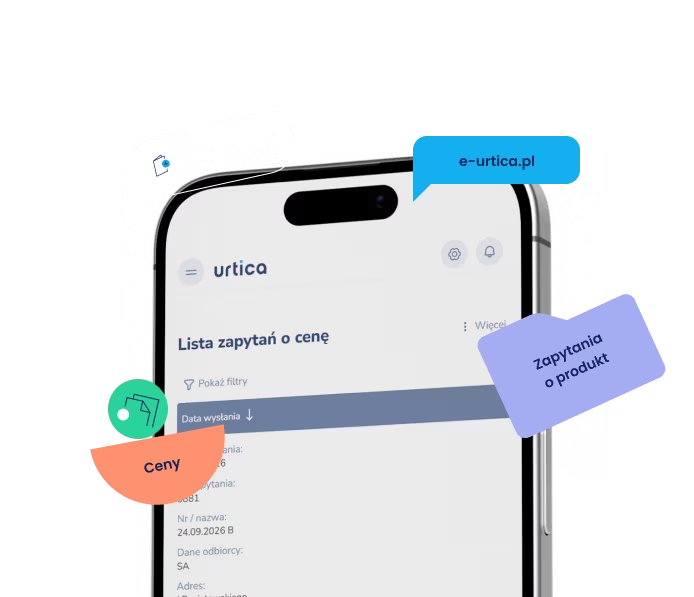
A good example of such a solution is e-Urtica, an online collaboration portal for Urtica’s clients – including hospitals and pharmacies. From my perspective, as someone who manages the portal on a daily basis and is in contact with its users, it is clear that the tool is no longer merely a platform for handling after-sales processes, but has also become an important channel for communicating with customers. What were the early days of e-Urtica like?
We started with an idea which, looking back over the past two years, I would now call a prototype, although we didn’t think of it that way at the time. We launched a fully functional portal that addressed specific customer needs identified in satisfaction surveys. Initially, it covered complaint handling, logistics-related features and basic contact functions. We wanted to create a platform that would enable us to respond more efficiently to customers’ needs, provide them with important information and keep them updated on, for example, new additions to our product range.
Today, it is a much broader community. In addition to its operational functions, an educational dimension has also emerged – the Knowledge Module, comprising articles and webinars for users. This is of great value, as we can not only convey messages but also share up-to-date, practical industry knowledge. What role does e-Urtica currently play?
Today, we already have a platform that has been developing practically non-stop over the past two years. As well as handling complaints and logistics-related matters, we have access to electronic documents. We quickly integrated e-Urtica with KSeF, enabling customers to download invoices and credit notes from the platform that are compliant with this system.
The portal also provides access to selected medicinal product documentation and the Knowledge Module, and features an integrated contact database alongside an electronic communication tool. At e-Urtica, we also offer bespoke service tools for manufacturers, such as those for reporting the use of selected products in medication programmes or in emergency access to medical treatments.
For me, this is one of the most interesting aspects of e-Urtica’s development – the fact that the platform now supports not only business processes but also B2B communication. We can run training initiatives targeted at specific user groups, whilst doing so in a structured, professional environment. From your perspective, has e-Urtica changed the way you communicate with customers and partners?
It has certainly given us greater scope to run our business – both with clients and through initiatives carried out in collaboration with manufacturers. Email campaigns are a good example. They weren’t carried out on such a scale in the past, but now – thanks to the e-Urtica database and a good tool – we’re able to run entire information or communication campaigns centred on selected products and services.
You mentioned KSeF. I think this is a good example of how Urtica responds to market and regulatory changes – not only by implementing a technical solution, but also by explaining to clients what it actually means for them.
Yes, but I think KSeF is also an example of the ability to collaborate within the Pelion group, particularly with the PGF development team. It was a system that required testing, validation and very well-prepared documentation, as it affected the flow of invoices and settlement processes, so it had to work flawlessly right from the start.
We’ve discussed this topic at length with our clients and have organised a webinar on KSeF. The feedback from clients was that we are one of the companies that were able to clearly explain how the process of retrieving invoices and credit notes would work and, importantly, once the solution was launched, the process actually worked exactly as we had previously communicated.
e-Urtica at a glance
Electronic documents
invoices and credit notes, including integration with KSeF
Process support
quotations, complaints and logistics-related matters
Knowledge and communication
research articles, webinars and electronic communication
Market solutions
dedicated service and reporting tools
Cooperation
From need to solution
Taking a broader view of these solutions, it is clear that Urtica is developing tools not so much for its own needs, but also with a view to collaborating with business partners. Do pharmaceutical manufacturers approach us with challenges that go beyond distribution alone and also require technological or process-related support?
Our business partners – manufacturers in the pharmaceutical sector – approach us when they face a specific challenge – for example, the implementation or distribution of a non-standard product, or a process requiring special conditions or additional supervision. Depending on the situation, we support them with our team’s expertise, a well-designed process or specific technological solutions.
So it’s not about technology for technology’s sake, but about solving a very specific problem. Could you give an example of such a project?
Some time ago, one of our partners needed an electronic platform to oversee the pre-reimbursement distribution of a particular product.
We met on several occasions; the client described the end result they wished to achieve, and our developers and project managers proposed a concept and drew up a design for the solution. We prepared a working prototype, demonstrated it to the partner, listened to their feedback, implemented the required changes, and within a few weeks – closer to three than nine – we had a fully functional tool ready. The formal and legal process took longer than the actual development of the solution. Urtica took on the role of a technical adviser here: we were presented with a requirement, and after a relatively short time we delivered a ready-to-use tool that addressed it.
So the starting point is not a ready-made idea for a system, but rather the need for a partner: a product, a process, a constraint or a risk that needs to be properly understood and only then translated into a specific solution?
Yes, it usually starts with a challenge or a problem. A client comes to us with a business need, rather than a ready-made system specification. Our role is to understand this process, identify where we can actually help, and propose a solution that will be practical – both for our partner and for the users. We’re given a challenge and try to turn it into a working tool or service.
EXAMPLE OF IMPLEMENTATION
A platform for monitoring pre-reimbursement distribution
Need
An electronic tool for monitoring the pre-reimbursement distribution process.
Process
Needs analysis → concept → working prototype → partner feedback → implementation of changes.
Result
A ready-to-use, functional tool developed in the space of a few weeks.
Artificial Intelligence
AI as a support tool for specialists
These examples clearly show that technology is worthwhile when it addresses a specific process, need or risk. Many companies are talking about artificial intelligence these days, but in the pharmaceutical and hospital sectors, it is not enough simply to implement a trendy tool. This is a heavily regulated sector, requiring oversight, compliance and accountability for data. Do AI-based solutions really have practical applications in such an environment?
Yes, one of the ideas submitted in the internal competition was to use AI to analyse contracts with hospitals running to several hundred pages. Based on specific questions, the algorithm reads the contract, prepares answers and then configures it accordingly within the system. This was our first production-ready AI implementation and we learnt a lot from the experience, but today the solution is already up and running in production.
We also have a project that identifies strategic medicines in tender enquiries. Staff still verify the AI algorithm’s suggestions, but we have an additional layer of checks, which is very important in processes like this.
So AI doesn’t replace specialists, but rather supports them in analysing and organising information, and identifying elements that require attention?
Exactly. As things stand today, I don’t see AI as a tool that can replace people in such processes. At Urtica, our greatest asset is our specialists, their experience and their knowledge of the hospital market. We sometimes joke that our sales teams alone have hundreds of years’ worth of combined experience – and that simply cannot be replaced by an algorithm.
AI, on the other hand, can provide significant support for day-to-day work: speeding up document analysis, flagging risks, organising data, or providing additional checks in processes where accuracy and precision are crucial. However, oversight, validation and decision-making must still remain in human hands. Within a few years, such tools could significantly boost the potential of companies such as Urtica, provided they are implemented responsibly.
Quote from the interviewee
“Supervision, validation and decision-making must still be carried out by humans.”
Director of Development
Urtica Sp. z o.o.
Further development
Innovation begins with a need
I’d also like to ask about the very concept of innovation. It features in the name of your department, but what does it actually mean in the context of Urtica? Are we talking primarily about technology, or rather about how we respond to the needs of customers, partners and internal teams?
For me, innovation is a response to needs – it is a change that must stem from something. I don’t think of innovation solely in terms of large-scale, groundbreaking implementations. Sometimes innovation is a new module on a platform, sometimes it’s a process improvement, and sometimes it’s a solution that enables a customer, partner or employee to do something faster, more easily and more securely.
We intend to continue developing e-Urtica as a digital platform for collaboration with clients. We regularly gather user feedback and, based on this, implement improvements and plan new modules that meet the needs of our clients and business partners. At the same time, we are developing internal systems that support the work of our teams and the management of processes specific to the hospital sector. We are also aware that Urtica’s development is often driven by new challenges raised by our partners. We analyse them, look for possible solutions and – if a decision is made to proceed – we take action. Such projects arise on an ongoing basis and are often the very impetus for us to create further tools or services.
In our conversation, the theme of responding quickly to needs and working together to find solutions often comes up. In your opinion, what is it that most sets Urtica apart in this approach to development?
I get the feeling that Urtica’s strength lies in its team, who are really keen and genuinely enjoy what they do – they simply love their work. This gives us a very strong sense of motivation and allows us to take a proactive approach to business development. Even in our dealings with producers, it’s often the case that when we spot a need or a challenge, we immediately – sometimes even whilst the conversation is still going on – try to work out how we might address it.
We’ve talked a lot about technology projects, processes and solutions that support the day-to-day work of Urtica and its partners. Is there a particular area or project that has made a particularly strong impression on you – not just professionally, but also personally?
All the projects are important to me, but if I had to pick one that has a particularly strong emotional impact on me, it would be the work of the Urtica Dzieciom Foundation. This is a story that began at Urtica back in 1997 – with a project to help children with cancer and blood disorders.
Today, I have the opportunity to be closely involved in this work from an organisational perspective as well. In my professional life, many projects are rewarding because they improve things or solve a specific problem. In the case of the Foundation, this satisfaction is different – it’s about activities that simply help children and young people, allowing them to escape, if only for a moment, from the emotional burden associated with cancer. This gives me a very positive drive and a sense that we are genuinely making a difference.